

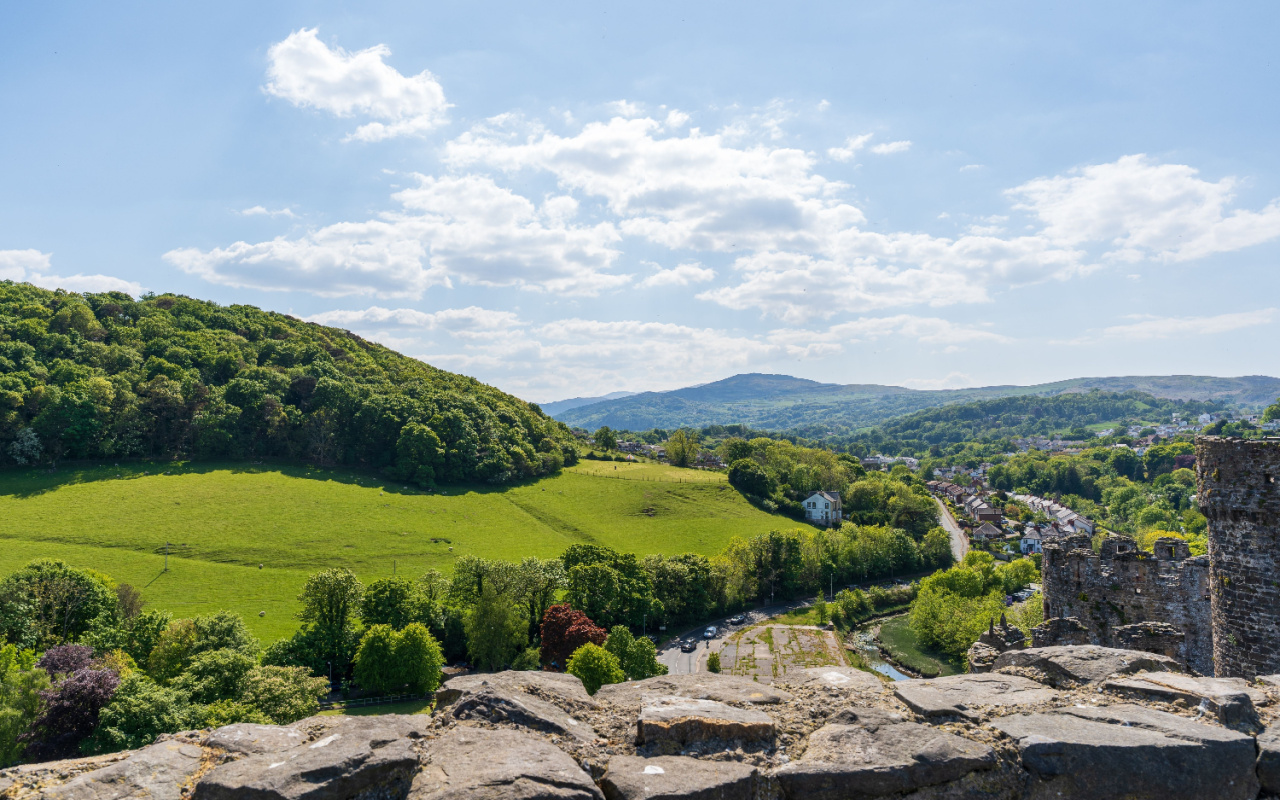
There’s a moment, just after you cross the estuary and the town walls come into view, when Conwy stops you in your tracks. Towers rising above rooftops, a harbour glittering in the distance, mountains stacking up on the horizon, it’s a lot to take in for a town of this size. I’ve visited a handful of times now, and it still gets me every time.
Conwy packs a remarkable amount into a very small space. A UNESCO World Heritage Site, a record-breaking cottage, Elizabethan grandeur, and one of the finest medieval walks in Britain, all within a few minutes’ walk of each other. If you’re planning a trip to North Wales and haven’t put Conwy on your list yet, here’s why it absolutely should be.
Conwy Castle
No visit to Conwy starts anywhere else. Conwy Castle has dominated this town for over 700 years, and according to Cadw, it remains “one of the most magnificent medieval fortresses in Europe.” That’s not hyperbole.
Built by Edward I between 1283 and 1287, the castle was designed to impress and intimidate in equal measure. What surprises most people is how much of it survives. The high curtain wall and eight lofty towers are still very much intact, and inside you’ll find the most complete set of royal residential rooms anywhere in England or Wales — not even the Tower of London comes close.
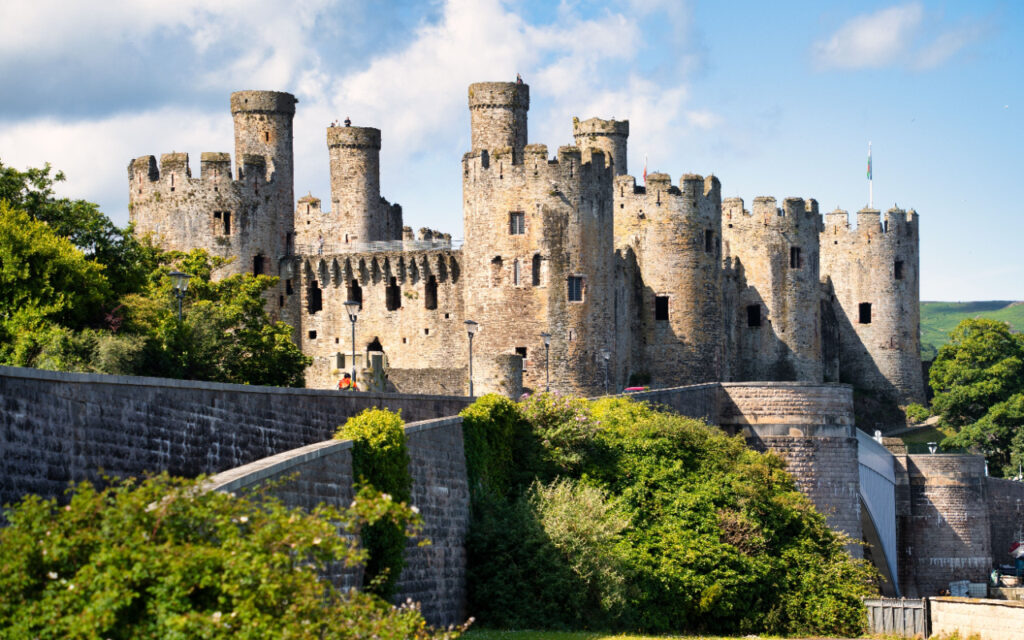
Climb the spiral staircases in the great towers and you’ll be rewarded with a view that genuinely takes the breath away. Spread out below you are the harbour and narrow streets of the town, still enclosed by their medieval walls, with Eryri (Snowdonia) rising dramatically in the distance. If you look towards the river, you can also spot the elegant lines of Conwy Suspension Bridge — more on that shortly.
One fascinating detail: traces of lime render on the castle walls suggest this “darkly forbidding fortress was originally white,” gleaming across the estuary like something from a fairytale.
Conwy Town Walls
Most people walk to the castle and forget to look up. The town walls encircling Conwy are, as Cadw puts it, “among the finest and most complete in Europe” — and they’re free to walk.
Stretching for three quarters of a mile with 21 towers and three original gateways, the walls form an almost unbroken ring around the medieval town. If you have a head for heights, you can walk along the top, looping above the cramped streets below with views out over the estuary and up to the castle. It’s one of the best free experiences in Wales.
Do note that the terrain is rated strenuous — the further along you go, the steeper the climb. Wear sensible shoes, hold the handrails, and take your time. It’s worth every step.
Plas Mawr
Tucked behind an unassuming gatehouse on the High Street, Plas Mawr is one of those places that catches you completely off guard. The name means “Great Hall” in Welsh, and Cadw describes it simply as “the finest surviving Elizabethan town house anywhere in Britain.”
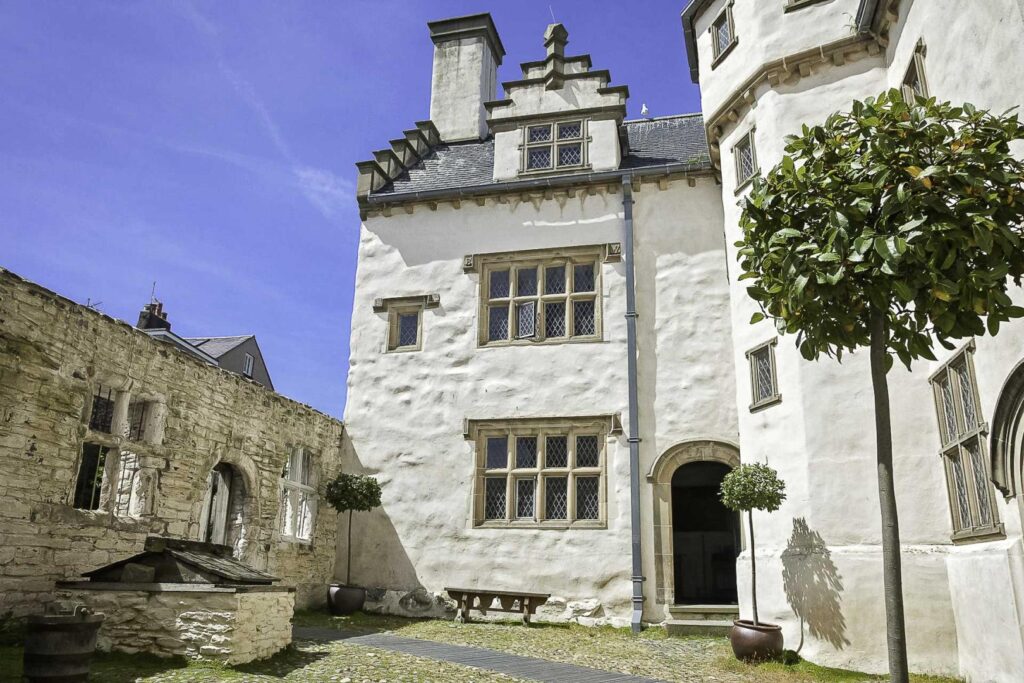
Built between 1576 and 1585 by Robert Wynn, a prosperous local merchant who clearly wanted the world to know it, Plas Mawr is a celebration of Tudor wealth and craftsmanship. His initials — R.W. — appear repeatedly in the building’s vividly painted ornamental plasterwork, which has been painstakingly restored to something close to its original glory.
You rise through a series of terraces to explore 17 impressive rooms, each revealing something new. The house spent centuries as a courthouse, a school, and even an art gallery, which is partly why it has survived so miraculously intact. Give yourself at least an hour here — it rewards slow exploration.
Conwy Suspension Bridge
Just outside the castle walls, the Conwy Suspension Bridge is easy to pass without a second glance. That would be a mistake. Built in 1826 by Thomas Telford, it was one of the first suspension bridges of its kind in the world — a piece of engineering history sitting quietly beside a medieval fortress.
The best view of the bridge is actually from the East Barbican of the castle, where it frames beautifully against the river and the hills beyond. The bridge’s towers were deliberately designed to echo the castle’s own turrets, creating a visual harmony between the ancient and the modern that still works brilliantly nearly 200 years on.
The Smallest House in Great Britain
On the quayside, squeezed between its neighbours, stands a tiny red cottage that has been pulling visitors to Conwy for decades. Measuring just 72 inches wide and 122 inches tall, the Smallest House in Great Britain holds the Guinness World Record for its dimensions — and with just 1.5 square metres of usable floor space, it’s hard to imagine how anyone actually lived here.
Remarkably, someone did. The house was reportedly last occupied in 1900 by a fisherman who stood over six feet tall. How he managed is anyone’s guess. It’s a quirky, charming stop that takes no more than ten minutes, but it’s the kind of detail that makes Conwy feel genuinely unlike anywhere else.
Conwy Harbour and Quayside
After ticking off the castle and the walls, I always find myself gravitating back to the harbour. The quayside has a relaxed, unhurried atmosphere — fishing boats bobbing on the water, seafood stalls set up along the front, locals and visitors sharing benches in the sun. It’s a good spot for a bowl of Conwy mussels, which are something of a local speciality.
From here you can also see Conwy Railway Bridge, the last surviving tubular bridge designed by Robert Stephenson, which carries the rail line across the estuary. It’s a striking piece of Victorian engineering, and easy to appreciate from the waterfront without any effort at all.
Bodnant Garden (nearby)
A short drive south of Conwy along the A470, Bodnant Garden is one of the finest gardens in Britain — and well worth an afternoon of anyone’s time. Managed by the National Trust and spread across 80 acres, the garden contains formal Italianate terraces, woodland dells, meadows, and an arboretum home to rare Champion Trees and five National Collections of plants.
The famous Laburnum Arch in late spring is spectacular, but Bodnant rewards a visit at any time of year. The backdrop of the Carneddau mountains of Eryri adds a drama that few gardens can match. If you’re travelling with family, there’s a natural play zone at the Far End, and a Pavilion tearoom serving hot food and drinks throughout the day.
Planning Your Visit
Conwy is compact enough to explore on foot, and most of the main attractions sit within a few minutes’ walk of each other. The castle car park is the most convenient starting point if you’re driving in. Conwy train station is just a short walk from the castle, making it easily accessible by rail if you’d rather leave the car behind.
Summer brings the most visitors, but the town handles crowds well given its size. Spring and early autumn are, in my opinion, the best times to visit — the light is often spectacular, the queues shorter, and the hills surrounding the town are at their most photogenic.
Conwy Is Worth More Than a Day Trip
I’ve done Conwy as a day trip and I’ve stayed overnight, and I’d recommend the latter every time. Once the coaches leave and the town quietens down, there’s a different quality to the place — the castle lit up against a darkening sky, the smell of salt off the estuary, the bells of St Mary and All Saints carrying across the rooftops.
It’s the kind of town that gets better the longer you stay.
