

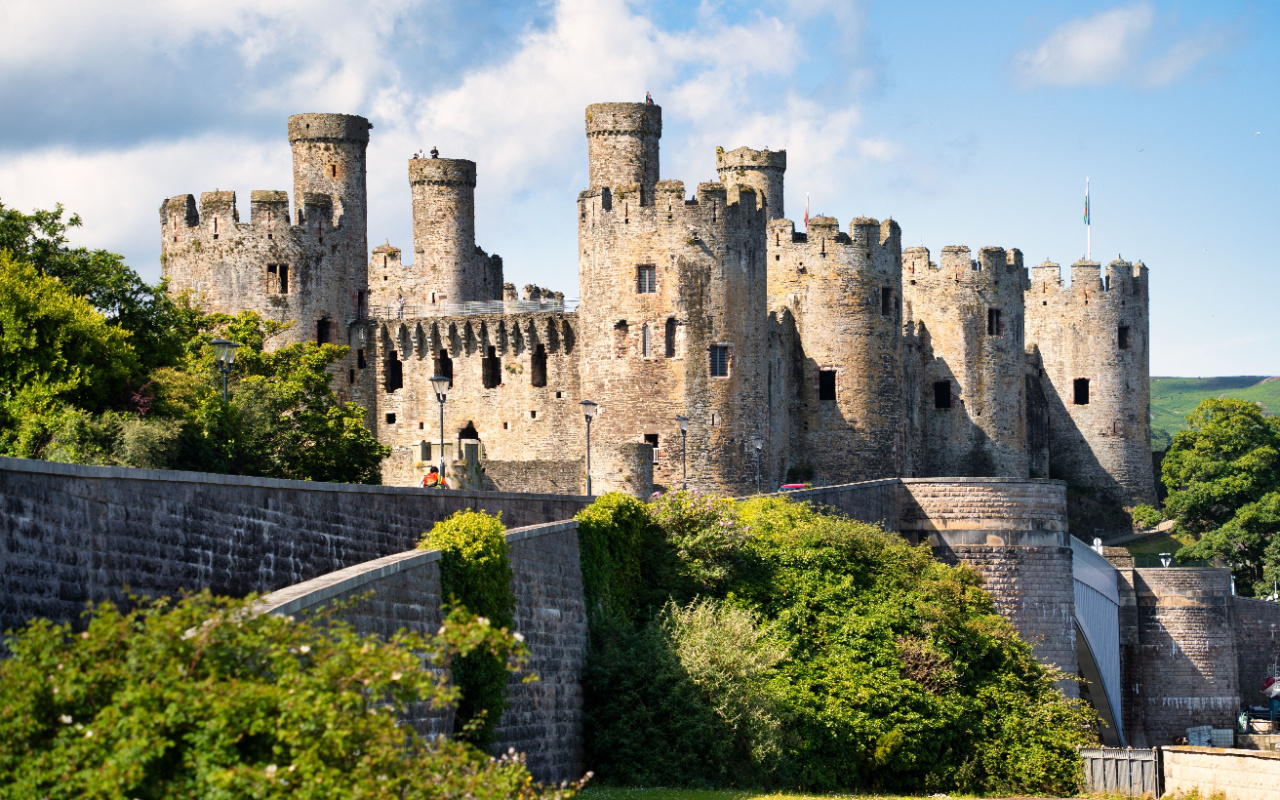
There are places that stop you in your tracks the moment you see them. Conwy Castle is one of them. Rounding the bend into the walled town of Conwy on a grey Welsh morning, I caught my first glimpse of those eight great towers rising above the estuary and honestly, I understood immediately why people travel from across the world to stand where I was standing.
If you’re planning a trip to North Wales, Conwy Castle isn’t just worth adding to your itinerary. It should be the reason you build your itinerary around it.
A Brief History of Conwy Castle
To truly appreciate Conwy Castle, it helps to know a little of what you’re walking into. Edward I of England commissioned the fortress in 1283, at the height of his campaign to conquer Wales. He tasked his master mason, James of St George (widely regarded as the greatest military architect of the age) with designing and building both the castle and the town walls that still surround Conwy today. Remarkably, the two were constructed together in roughly four years. The scale of that achievement becomes clear when you’re standing inside it.
The castle wasn’t just a military statement, it was a seat of royal power. It contains the most intact set of medieval royal apartments in Wales, and its Great Hall would have hosted the kind of scenes you’d expect from a major 13th-century stronghold.
History, of course, didn’t stop there. In 1294, Conwy was briefly besieged during a Welsh rebellion led by Madog ap Llywelyn. A century later, a trapped Richard II sought refuge within its walls from the forces of Henry Bolingbroke, the man who would become Henry IV. It was inside the castle’s chapel that Bolingbroke’s emissary, Henry Percy, promised the king safe passage if he abdicated. That promise was broken. Richard died in captivity at Pontefract Castle in 1400.
In 1401, during the rebellion of Owain Glyndŵr, the castle was seized in a bold surprise attack. Two of Glyndŵr’s cousins, Rhys and Gwilym ap Tudur, disguised themselves as carpenters, killed the guards, and held the fortress for three months.
The castle’s final act came during the English Civil War. Initially a Royalist stronghold, it fell to Parliamentary forces in 1646 and was subsequently slighted — deliberately damaged to put it beyond military use. By the late 17th century, it had fallen into ruin. And yet, more than 700 years after its construction, the walls and towers still stand. That alone says something.
What to Expect on Your Visit
Conwy Castle is managed by Cadw, the Welsh Government’s historic environment service, and it’s in excellent shape for a ruin. I’d set aside at least two to three hours, and that’s if you’re not the type to linger, which, once you’re up on the battlements, you will be.
The Battlements
The highlight, without question, is walking the full circuit of the battlements. The restored spiral staircases are steep and worn smooth in places, but the climb is absolutely worth it. At the top, you get uninterrupted views over the Conwy estuary, the peaks of Eryri (Snowdonia) in the distance, and the tightly packed streets of the medieval town below. Cadw themselves have written that “there isn’t a better place in Britain to stand on the battlements and dream” — and having done it, I’m not going to argue with them.
The Royal Apartments and Great Hall
Back at ground level, the rooms tell their own stories. Information boards guide you through what each space would have been used for, from the royal apartments — the most complete of their kind in Wales — to the Great Hall. The scale of the interior is striking when you consider how quickly it was all built.
The Town Walls
Don’t leave Conwy without walking at least part of the town walls. At roughly 1.3km in length, the walls are one of the best-preserved medieval circuits in Europe, and they’re included with your castle ticket. The views from the walls over the rooftops and harbour are completely different from those at the castle — and equally worth your time.
Practical Information
Getting there: Conwy is easily reached by train — the station is a short walk from the castle — or by road via the A55. Parking can be tight in peak season, so arriving early or using a car park outside the town walls is a good idea.
Opening times:
- 1 March – 30 June: 9:30am – 5pm
- 1 July – 31 August: 9:30am – 6pm
- 1 September – 31 October: 9:30am – 5pm
- 1 November – 28 February: 10am – 4pm
The castle is closed on 24–26 December and 1 January. Last admission is 30 minutes before closing.
Admission prices (from September 2025):
- Adults: £12.50
- Seniors (65+): £11.20
- Juniors (aged 5–17) / Students: £8.70
- Family (2 adults, up to 3 children): £40.00
- Children under 5: Free
- Cadw members: Free
An audio guide is available for £3.00 (£2.50 for tour groups), and Cadw members get it free.
Accessibility: The path from the visitor centre to the castle is steep and includes steps. The site is rated Level 4 (Strenuous) for walking difficulty. Accessible toilets are available at ground level.
What Else to See in Conwy
A full day in Conwy is easily filled. After the castle and walls, Plas Mawr — a beautifully preserved Elizabethan town house just a short walk away — is well worth an hour of your time. The harbour is worth a stroll too, particularly in the late afternoon when the light hits the estuary and the castle towers reflect off the water.
Is Conwy Castle Worth Visiting?
Without hesitation: yes. Part of the UNESCO World Heritage Site known as the Castles and Town Walls of King Edward in Gwynedd, Conwy sits alongside Beaumaris, Harlech, and Caernarfon as one of the finest examples of late 13th-century military architecture in Europe. But where Conwy stands apart is in how completely it pulls you into its history — the battlements, the views, the stories soaked into every stone.
I came expecting an impressive ruin. I left thinking about Richard II standing in that chapel, about the men who built those eight towers in four extraordinary years, and about whether anywhere in Britain quite matches Conwy for atmosphere. I don’t think it does.
